Contamination-free supply of raw materials for sensitive products
The same questions arise time and again when it comes to the internal transport of raw materials:
How can products be introduced into or discharged from the process gently and safely?
How can seamless transfer between the individual processing steps be achieved?
How should different types of containers, such as big bags, drums, containers or sacks, be handled?
These and many other questions must be addressed afresh for every new project as well as for existing systems. HECHT Technologie provides the right solutions and concepts for all these requirements.
In the pharmaceutical and life sciences industries, many of the substances involved are also highly potent and therefore particularly hazardous. For numerous substances, OEB 5 (Occupational Exposure Band) conditions must be maintained to effectively protect personnel from potential health effects. This means that airborne exposure must remain below an OEL (Occupational Exposure Limit) of 1 µg/m³. At the same time, some materials must be protected from environmental influences under all circumstances. Examples of such sensitive materials include infant formula, food for people with allergies and materials used in surgical procedures.
Bone cement is used in many orthopaedic procedures but must first be prepared from several components. A leading manufacturer produces this “cement” in Ireland under the strictest cleanroom conditions. HECHT Technologie ensures the reliable supply of raw materials and the homogeneous mixing of this highly sensitive product with a complete process line. All machines were manufactured from the highest-grade stainless steel. In addition, all surfaces have an arithmetic mean roughness of Ra < 0.8 µm.
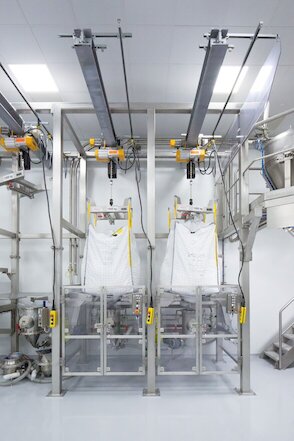
Hygienic conveying and mixing process with ProClean technology
Five big bag discharge stations with cantilever gantries and containment liner systems were used for feeding the raw materials. This allows the big bags to be connected without contaminating the product. To ensure precise mixing ratios, some of the big bag discharge stations are mounted on weighing modules and operate according to the loss-in-weight principle. For transfer to the mixer, pneumatic conveying with the ProClean Conveyor (PCC) has become one of the leading methods for closed product transfer. Protecting the operator and preventing cross-contamination are the highest priorities. However, the composition and moisture content of the conveyed material must also be taken into account. For substances with a low minimum ignition energy, it is essential to prevent the formation of an explosive atmosphere and to comply with the applicable Ex-zone requirements. If necessary, production must take place in an oxygen-free, inert atmosphere. The machines should also be easy to operate and clean.
Developed specifically for these requirements, the ProClean Conveyor meets the stringent GMP requirements of pharmaceutical manufacturing.
At first glance, the operating principle of the ProClean Conveyor PCC differs only slightly from that of conventional pneumatic conveying systems operating with either positive pressure or vacuum. To maintain the vacuum, the system must operate as a closed system. The ProClean Conveyor PCC uses the plug conveying principle, which requires less conveying air. It can therefore operate with a comparatively small filter area that has been specially designed for this purpose.
With ring filter technology, the filter body forms an extension of the separator vessel. From easy installation and removal to compliance with hygienic design principles, this technology offers numerous advantages. The filter fabric is also fully FDA-compliant. Further benefits include the durability of the filter design and its resistance to filter breakthrough.
During conveying, the product-gas mixture is drawn from the feeding point through a hose or piping system and enters the conveyor’s separator vessel through the product inlet valve. A shut-off valve or airlock can then supply the tablet press with a defined quantity of powder, depending on the customer’s requirements. Tableting is performed using a rotary tablet press and the associated powder dosing system.
Another design-related advantage of the housing cover is the arrangement of the connections. The vacuum and compressed-air units are mounted on the side of the housing and therefore do not need to be removed when changing the filter or carrying out cleaning and maintenance work.
Once all substances have been added in sufficient quantities, the mixing process begins in a ploughshare mixer manufactured by Lödige.


Efficient and safe filling with the LBK-EC filling head
For further in-house processing, the finished mixture is transferred into big bags after the mixing process. A vacuum conveyor transports the product to two filling stations, where it is filled into the big bags.
For this sensitive process, HECHT developed the patented LBK-EC (“Easy Connect”) filling head for containment applications. It enables simple, safe and fast filling without the need for auxiliary or consumable materials. Filling takes place at two stations, with each lined big bag being filled using a liner filling head. It enables the closed filling of any type of container equipped with an inner liner. High containment is maintained even during container changes through the use of protective films. When no container is connected, a protective film seals both the filling head and the access port. This protects both the operator and the product from contamination.
The use of this technology eliminates the need for complex isolator systems during filling. By connecting every stage of the manufacturing process with closed systems, contamination-free production can be achieved. Product protection and, in particular, the prevention of cross-contamination are the primary focus. Materials intended for orthopaedic procedures, such as hip surgery, must never be contaminated.
Thanks to its ergonomic operation, high level of occupational safety and suitability for OEB 5 applications, the LBK-EC sets new standards in dust-free and user-friendly filling technology. This is a key factor in meeting the stringent containment requirements of medical technology.