Moving away from rigid processes: raw material feeding in continuous pharmaceutical manufacturing
Compared with the traditional batch process, which still dominates the pharmaceutical industry, continuous manufacturing of medicinal products not only offers advantages in terms of production output, but also represents a decisive factor for product quality and process development through comprehensive and continuous process analysis data. In contrast to the batch-based approach, continuous production can significantly reduce manufacturing costs, shorten production times and markedly increase overall efficiency.
A renowned international manufacturer of pharmaceuticals, with several production sites in Germany, achieved a significant milestone for the industry in terms of continuous manufacturing in the pharmaceutical sector with a new continuous production plant. Aim was to ensure GMP-compliant raw material feeding to the continuous mixing technology (CMT) across two production lines, whilst maintaining a closed, safe containment system for product transfer, and to implement a continuous dosing function.
Dust-free systems (designed up to OEB Level 3), high plant availability and an automatic CIP (Cleaning in Place) function were the client’s main requirements. Taking into account the principles of sustainability and Industry 4.0, the aim was to achieve fully automated integration into the overall process, with a focus on the energy efficiency of the systems used as well as on regional management and manufacturing.
Low-dust big bag emptying
After goods receipt, the Big-Bags containing various active pharmaceutical ingredients and excipients (APIs) are transported to the systems, which are split across two rooms and each equipped with five Big-Bag discharge stations. A discharge station essentially consists of the following components:
- The connection system forms the core component for a safe and dust-free connection of the Big-Bags.
- The product to be discharged falls gravimetrically into a suction shoe, which serves as the interface to the subsequent process step.
- The support table bears the weight of the Big-Bag and secures heavy loads.
- A massage paddle acts as a discharge aid to loosen hard-flowing products.
- The corresponding frame serves to mount the connection system and the Big-Bag support. A pneumatic tensioning device is used to tauten the Big-Bag outlet. Depending on the area of application, operating height, and installation dimensions, various additional options are available.
- A monorail beam with a chain hoist as well as a lifting beam are necessary to safely lift the Big-Bags and position them above the connection system for discharge.
The special feature of this project is the 5-fold cantilever gantry, consisting of three complete gantry units with two cross braces. This custom construction led to significant savings in the manufacturing process and enabled simplified assembly within the restricted space conditions. The outlet connection system (AAS-EF) ensures low-dust discharge using two-hand lever technology.
Thanks to the dedusting filter with pneumatic cleaning integrated into the system, dust is separated directly within the connection system, preventing carry-over into the extraction system. An additional inline screening machine provides safety screening and retains all foreign particles that must not enter the product or that exceed a specific core size.
A mobile transport trolley enables fast transport of the connection system and the connected suction shoe to a separate washroom for wet cleaning.


Produktschonende Förderung
Der Transport zum nachgelagerten Prozessschritt ist eine anspruchsvolle Anwendung in der Schüttguttechnologie. Der Schutz des Bedieners sowie das Vermeiden von Kreuzkontamination haben hierbei oberste Priorität. Im Kundenprojekt erfolgt nach der staubarmen Entleerung der Big-Bags der Übergabeprozess an das pneumatische Fördersystem (PCC) in die angrenzenden Räumlichkeiten über ein strömungstechnisch optimiertes und speziell konstruiertes Rohrleitungssystem.
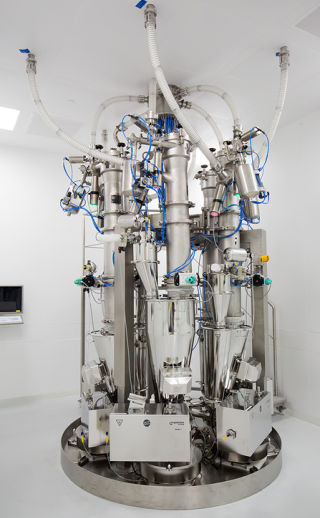
Das Fördersystem besteht aus insgesamt zehn ProClean Conveyorn (PCC), die für eine sichere und produktschonende Förderung von Pulvern und Granulaten bestimmt sind. Abhängig von der Wahl der Zusatzoptionen garantiert der PCC eine Steigerung der Effizienz und Flexibilität und gewährleistet die Qualität und Sicherheit des Prozesses.
Das Design der PCCs wurde kundenspezifisch auf die Anforderungen des Arzneimittelherstellers angepasst:
- Die leicht konische Bauweise des Abscheidebehälters erleichtert den Produktaustrag von schwerfließenden Pulvern für einen einwandfreien Entleerprozess.
- Das spezielle ViwateQ-Oberflächenfinish verhindert Produktanhaftung im Abscheidebehälter. Dieses Verfahren wurde speziell für die Pharma- und Lebensmittelbranche geschaffen, stellt eine neue Dimension der Oberflächenbehandlung dar und schafft zusätzlich ideale Bedingungen zur Reinigung.
- Zur Verhinderung von Brückenbildung ist der ProClean Conveyor mit einer Austragsklappe mit pneumatischem Vibrator versehen.
- Ein im ProClean Conveyor integriertes Wägesystem unterstützt die nachgelagerte Differential-Dosierwaage. Somit wird eine sehr schonende und sehr exakte kontinuierliche Verwiegung und Dosierung mit hohen Durchsatzleistungen erreicht.
Im letzten Prozessschritt beschicken die fünf Differential-Dosiermaschinen den kontinuierlichen Mischer.